











Our Church School Vision
Vision
Rooted in 1 Corinthians 13:7–8a

Our vision is
Love for God, Love for Each Other,
Love for Learning
Rooted within 1. Corinthians 13:7-8a
Vision: Love for God
Verse: "Love is a safe place of shelter,...Love never stops loving"
God is love and He provides us a safe place of shelter and never stops loving us. We in return love God because He first loved us.
Vision: Love for each other
Verse: "for it [love] always believes the best for others"
Love believes the best for others and this is seen as we love each other.
Vision: Love for learning
Verse: "Love never takes failure as defeat, for it never gives up"
Love never takes failure as defeat and never gives up and so as we love learning, we don't take our failures as defeat and never give up.
Who We Are
We are a diverse school community, serving families from all different backgrounds and nationalities. Our Christian vision affirms that every individual is created and loved by God, and therefore deserves dignity, respect and care (Genesis 1:27). As a result, our school is a place where:
- Everyone feels they belong.
- Differences are welcomed and celebrated.
- Relationships are characterised by mutual respect.
Why We Are Here
Inspired by God’s enduring and never-failing love, we exist to enable all pupils to flourish academically, spiritually, socially and emotionally.
Because love is a safe place, believes in others, doesn’t give up and keeps on loving:
- Pupils feel safe and are willing to take risks in their learning.
- Pupils develop resilience and confidence when faced with challenge.
- Pupils are encouraged to aspire to and achieve their full, God-given potential.
Our vision is lived out through three interdependent strands:

These reflect Jesus’ commandment to love God and our neighbour (Matthew 22:37–39) and provide the foundation for life in our school.
How We Live Out Our Vision
Love for God
 We believe love begins with God, and so we place worship and spiritual development at the heart of school life, enabling pupils to grow spiritually and develop an understanding of God’s never-failing love. Our Christian vision actively informs all leadership decisions, ensuring that policies, curriculum and practice meet the spiritual needs of all learners, regardless of faith or belief. Inspired by the call to stewardship, we teach respect and care for God’s creation.
Implementation
- Daily collective worship rooted in biblical teaching and reflection
- Curriculum and policies shaped to promote spiritual development
- Strong emphasis on stewardship and care for creation
- Partnerships that broaden pupils’ understanding of God’s world
- Opportunities for prayer, reflection and spiritual growth
Impact
- Pupils understand that caring for the world reflects love for God, leading them to act as responsible stewards. Our Eco-Warriors promote and demonstrate responsibility, respect and pride in their school environment.
- Through our link school in Kenya, pupils develop global awareness, understanding Christian love in action beyond their own context.
- Pupils show respect for different faiths and world-views because they understand the inclusive nature of God’s love.
- Because pupils understand God’s love, Chaplaincy Team members confidently lead worship and support others in prayer.
Love for Each Other
 Inspired by love that “is a safe place, believes in others and doesn’t give up,” we create a happy, secure, calm and disciplined environment where every individual is known, valued and respected. We prioritise relationships built on compassion, trust and forgiveness, and reflect Jesus’ example of servant leadership. Our Christian vision calls us to nurture mental, emotional and social wellbeing.
Implementation
- Strong emphasis on positive relationships and inclusion
- Happiness Heroes and Chaplaincy Team pupils model kindness, friendship and support
- A structured PSHE programme (My Happy Mind) which supports mental health, emotional literacy and wellbeing
- Close partnerships between home, school, parish and the wider community
- Food Pantry to provide for our most vulnerable families
- A partnership with Signature House builds meaningful relationships with our elderly community while teaching and inspiring our pupils.
Impact
- Pupils confidently support one another, promoting friendship, empathy and care
- Pupils feel safe, valued and supported and know who to turn to for help.
- Improved wellbeing enables pupils to engage positively with learning and school life
- The school community demonstrates a strong sense of belonging and mutual respect
- Meaningful relationships are formed between pupils and members of the elderly community promoting mutual respect and understanding across generations.
- As a result, a culture of compassion, support and shared responsibility is clearly evident across the school
Love for Learning
 Love that “believes in others” underpins our high aspirations for all learners and how we believe in their unlimited potential. Guided by our Christian vision, we recognise each child as uniquely created and infinitely valued by God. This belief drives our commitment to enabling every pupil to flourish and achieve their God-given potential academically, socially, emotionally, and spiritually. Learning is understood as a lifelong journey that extends beyond the classroom, shaped by hope, encouragement, aspiration, and equity for all.
Our Christian vision calls us to ensure that no child is limited by circumstance. In response, love motivates us to provide rich, meaningful learning experiences and opportunities that nurture talents, broaden horizons, and inspire ambition.
Implementation
- A highly equitable, broad, and balanced curriculum, shaped by our Christian vision and adapted through quality‑first teaching, targeted intervention, and enrichment
- Teaching underpinned by strong pedagogical understanding, high expectations, and inclusive practice
- Stimulating, purposeful learning experiences tailored to individual strengths, interests, and needs
- A well-developed and inclusive programme of extracurricular activities, rooted in love and social justice, ensuring all pupils have equal access to clubs, teams, and opportunities regardless of background or need
- A wide range of clubs, including sports, creative arts, music, STEM, and leadership, promoting teamwork, resilience, and confidence.
- Educational trips and residential experiences that deepen learning, build independence, and develop character.
- Opportunities for pupils to engage with democratic and civic life, including visits from the local MP, school councillors, Dorset Council representatives, and community leaders.
- Enrichment through visits and workshops led by organisations such as the RNLI, supporting safety, citizenship, and community responsibility.
- Strong links with the wider community that bring learning to life and support pupils’ understanding of the world as God’s creation.
- Ongoing professional development (CPD) for staff, reflecting our belief that adults, as well as pupils, are lifelong learners.
Impact
- Pupils make strong progress because learning is ambitious, accessible, and responsive to individual needs
- Pupils develop confidence, curiosity and resilience because they know they are valued and capable
- All pupils, including the most vulnerable, access a rich range of extracurricular opportunities that enable them to discover interests, develop talents, and flourish beyond the classroom
- Pupils gain cultural capital and a deeper understanding of their place in the world through trips, visits, and real‑life experiences
- Engagement with civic leaders and community organisations helps pupils understand democracy, service, and responsibility, rooted in Christian values
- Staff expertise continues to strengthen through reflective CPD, enhancing outcomes and experiences for pupils
- A shared culture of lifelong learning, hope, and aspiration is evident across the whole school community
Our Impact as a Whole School Community
Because our vision is rooted in love that “never stops loving,” it shapes every aspect of school life.
As a result:
- Pupils flourish as compassionate, respectful and responsible individuals
- Pupils understand how to live out love through their actions, relationships and learning
- The whole school community demonstrates a strong sense of belonging, hope and aspiration
COLLECTIVE WORSHIP
Collective worship is deeply rooted in the school’s Christian vision and in 1 Corinthians 13:7–8a, it is invitational, inclusive and inspiring, enabling all pupils to engage meaningfully regardless of faith or background. It is carefully planned and sequenced to ensure clear progression, so that pupils’ biblical understanding, theological thinking and opportunities for spiritual reflection deepen over time. Using Bible stories as the framework to explore Christian Traditions and teachings, pupils are supported to reflect on how faith informs values, behaviour and decision‑making. Worship actively shapes the school community by nurturing the vision‑led values of love for God, love for each other and love for learning. It promotes dignity, compassion and respect, and provides pupils with opportunities to live out the vision in their relationships, learning and service to others. Click below to view our collective worship handbook.
Parents have the legal right to withdraw their child, either partially or wholly, from collective worship. Should a parent wish to do so, they are asked to inform the Headteacher. The school values open and respectful dialogue and would welcome the opportunity to discuss the provision and purpose of collective worship, ensuring that arrangements made are sensitive to the needs of the child while remaining consistent with the school’s Christian vision and inclusive ethos.
At Manor Park, spirituality means:
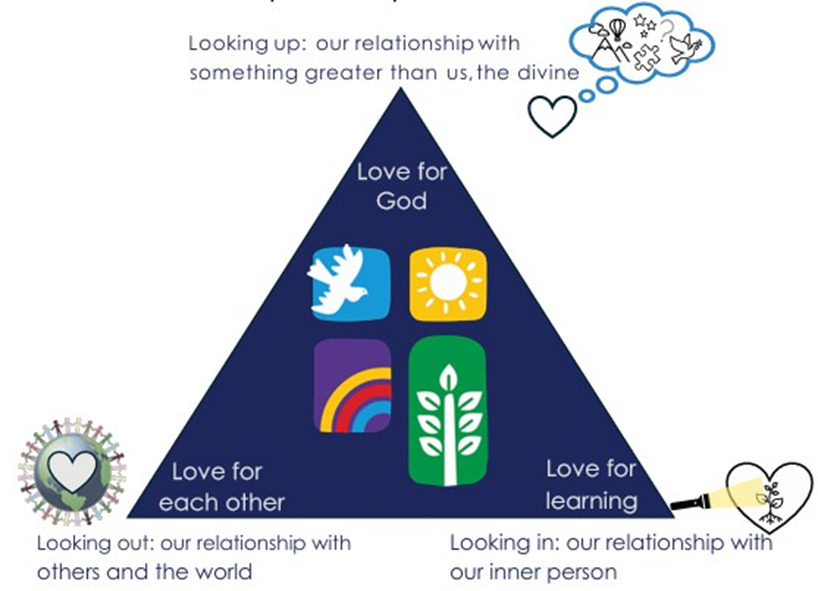
We are looking in, looking out and looking up with love and this is rooted in our belief that:
- Love is a safe place of shelter, for it never stops believing in the best for others.
- Love never takes failure as defeat, for it never gives up.
- Love never stops loving. 1 Corinthians 13:7-8a
Spirituality Symbols
Our Spirituality Symbols help us recognise spirituality in our school life. By using symbols to create a visual representation and linking them to spiritual capacities, our vision and the ‘looking in, looking out and looking up’ model, we are better able to recognise when pupils and adults are displaying these capacities and can be more intentional about planning opportunities for developing them. These symbols are used in collective worship and across the wider curriculum and school life, including when we ask the children questions and to help us focus on what these capacities of spirituality could look like:
 Looking in:
Is linked to our value ‘love for learning’ as it is about learning more about myself, my identity, my emotions and what I believe. This links easily with doing MyHappyMind, RE and PSHE. 
Some of these spiritual capacities are:
• Self-awareness
• Believing in themselves and not giving up when things are challenging
• Being guided by their beliefs and values
• Being willing to reflect on and learn from experiences of failure and success
 Looking out:
Is linked to our value ‘love for each other’ as it is about other people, the world and beauty. This links easily with science, history, geography, music, art and RE, and also MyHappyMind. 
Some of these spiritual capacities are:
• Empathising with others, in school and the wider world
• Being imaginative, creative and appreciating beauty in the world
• Being ready to say sorry and to forgive
• Being thankful for what is good in life and showing generosity to others
 Looking up:
Is linked to our value ‘love for God’ and is about asking big questions and enjoying wow moments. It links easily to forest school, RE, music and art. 
Some of these spiritual capacities are:
• Being able to enjoy moments of awe and wonder
• Being intrigued by mystery and open to the transcendent
• Showing curiosity and open-mindedness when exploring life’s big questions
• Being open to engage with stillness and silence in reflection, meditation and prayer
Opportunities for these spiritual capacities to be developed are planned and so are opportunities for spiritual experiences. Spiritual understanding is developed by providing a storehouse of spiritual wisdom through Bible and other faith stories and time is given to reflect on all of these. Occasions to see spiritual responses that are evident through actions are also planned for.